Family story
Cadet Weasel
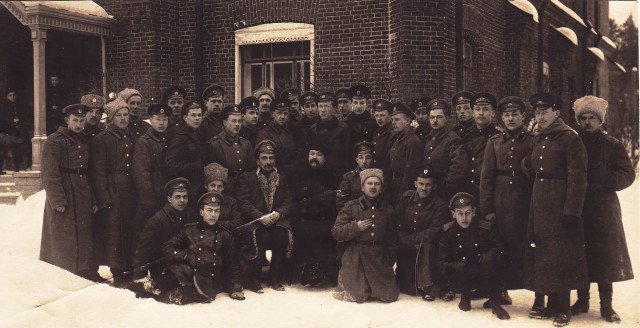
A group photograph of soldiers lay in the family album, and the painter’s son was recognized in it: an orientalist who spoke twelve languages. Nobody knew what he was doing in uniform.
Oskar Wiesel, the painter’s eldest son, was an ethnographer and a linguist. In the family he was remembered as a polyglot: twelve languages, among them Mongolian, Japanese and Sanskrit. It was also known that he was arrested twice and died in exile in 1939, labeled a "socially dangerous element, hereditary nobleman".
In the autumn of 2011, while going through the archive in Kazan, a group photograph of soldiers turned up among the pictures, and Oskar was recognized in it. Everyone was surprised, his own son included: why an orientalist would have a military career nobody in the family knew, and no trace of it had survived.
Lists from England
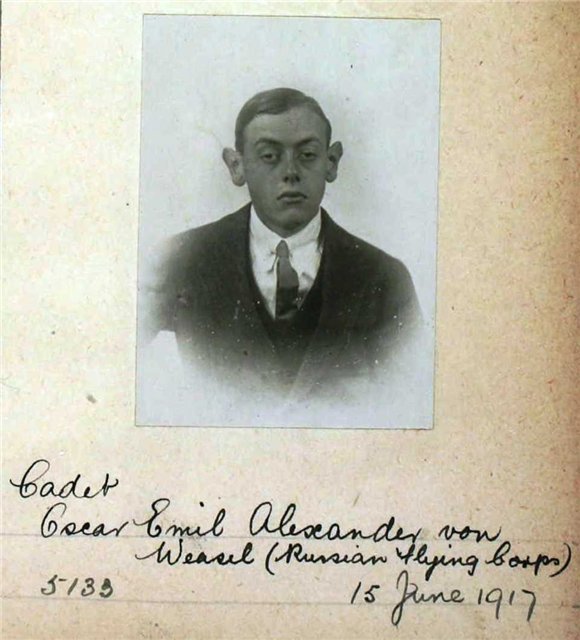
The answer came from London. Roman Firsov, a researcher of Russian military history, was working with the lists of cadets of the Russian Flying Corps sent to England in 1917 to learn to fly. Among some one hundred and twelve names was Weasel, Oscar Emil Alexander von.
The surname was not transliterated but translated: Wiesel is German for weasel, and that is exactly the word the English list used. There was no doubt about the man: the card gives his date of birth, 26 October 1895, Petrograd, and a home address, Fourth Line, house 1, Vasilyevsky Island. That is the Wiesel family address.
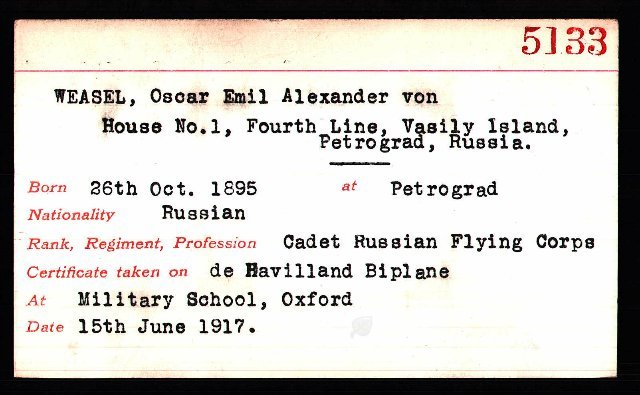
He took his certificate on 15 June 1917 at the military school in Oxford, flying a de Havilland biplane. In 1917 every pilot was accounted for at the highest level of the state, so nobody joined that group by chance.
What the photograph shows
The London researcher also went through the photograph itself. It was taken shortly before the group left for England, in the second half of February 1917, probably in Murmansk. Wiesel appears there as a volunteer of the educated class, a status that allowed shorter service, living outside barracks and an examination for officer rank.
The details show he was no newcomer: the shaped cap, the leather coat, a place in the front row. Next to the other cadets he looks like a dandy.
What happened to him between Oxford and exile, and how a tsarist officer became an orientalist, the family still does not know.