Family story
The vanished consul
The trail of the painter’s brother went cold in Italy in 1919. Finding out where and when he died took four years, three archives and a phone call from a stranger in France.
Oskar Wiesel, the elder brother of the painter, was a diplomat and an ethnographer. He served as consul in Norway, built a personal collection of Sami household objects and, early in the century, gave about a hundred of them to the Ethnographic Museum in St. Petersburg. That collection is still the core of the museum’s Sami holdings, and most of it is on permanent display.
In 1917 he was appointed consul general in Naples. After that the family knew nothing. The revolution found him in Italy, the last traces date from 1919, and what became of him afterward no one could say.
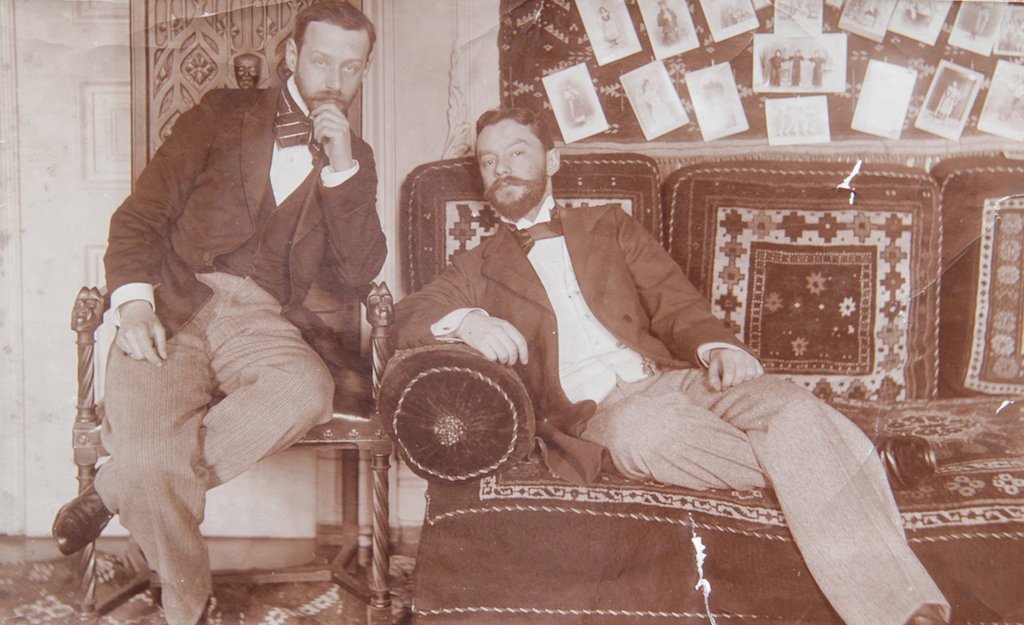
A letter from the foreign ministry archive
The first person to take up the consul’s fate was the historian Mikhail Talalay, who lives in Naples: he worked in Italian archives and published several articles about Oskar Wiesel. Progress was slow. Talalay warned that the archive of the Ministry of Foreign Affairs required clearance.
In the autumn of 2014 an ordinary letter went to that archive anyway, setting out the case in detail. They replied, asked follow-up questions and then went quiet for a long time. A few weeks later a registered envelope arrived in Paris holding a copy of Oskar Wiesel’s personnel file: a career documented up to 1917, and the full name of his wife, until then unknown in the family. Mariamna Pavlovna, born Kosagovskaya.
The St. Petersburg address directories showed where she had lived and turned up her brother Alexander. From there the thread led to her father: privy councillor Pavel Kosagovsky, governor of Vitebsk, Kursk, Odessa and Poltava, member of the council of the Ministry of the Interior. A man with a reputation: as governor he would dress as a merchant or a peasant and track down criminals himself, and he once interrogated the assassin of Alexander II.
Proof of the relationship, however, took another two years. Extracts from Kosagovsky’s own file named a daughter Maria among his children, but no Mariamna. Confirmation came only in 2017, in Lobanov-Rostovsky’s Russian Genealogical Book: the very last line of the Kosagovsky pedigree, a family of hereditary nobility traced to the sixteenth century, is Mariamna Pavlovna.
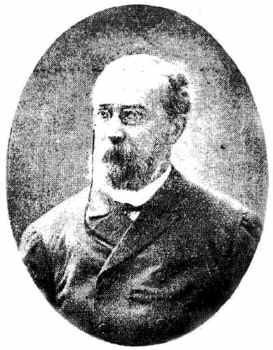
A playbill from Geneva
Along the way came evidence of a very different kind. In December 1915 the Grand Théâtre in Geneva staged a Russian ballet evening for the Russian victims of the war: Carnaval, The Firebird and Soleil de nuit, with Diaghilev, Stravinsky and an orchestra under Ansermet. The evening was held under the patronage of the Russian ambassador to Switzerland, Vasily Bakherakht, and of consul general Oskar Wiesel.
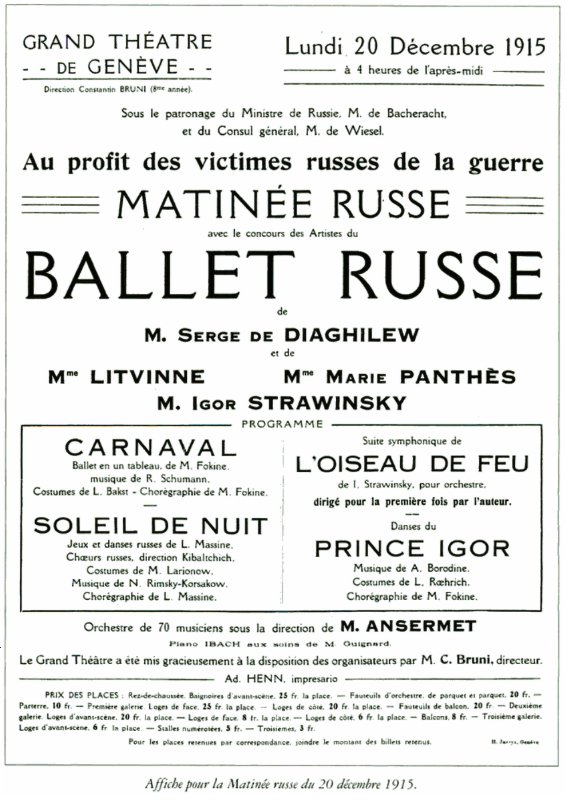
A file of fifty two pages
In the summer of 2017 the search moved to the State Archive of the Russian Federation, where a Moscow researcher went through the Italian files. The work took half a year, unhurried, and just before the new year the answer came: a file of fifty two pages. A will, consular correspondence, letters of condolence, envelopes.
Misfortune helped. After the consul’s death the Roman landlord who rented furniture to his widow stopped honoring the agreement, and she had to turn to the consulate for help. The official correspondence went into the archive, and the date went with it.
Oskar Wiesel died of tuberculosis on the night of 27 September 1918 in Plainpalais near Geneva and was buried in the Petit-Saconnex cemetery. He was fifty four. Swiss graves are cleared after twenty or thirty years unless the lease is renewed, so his grave is most likely gone.
Dear Mikhail Nikolayevich, last Sunday, 29 September, I buried everything I loved without reserve. He died on the night of the 27th, of heart failure. His mind was entirely clear for the last two days. He said nothing to me of death, and spoke of it only to Doctor Bess on the day he died, in French. In moments of despair I hear all of it again. I cannot believe he will not come back; it still seems to me that he has gone on a long journey.
Mariamna Wiesel, from a letter to the consulate, October 1918
A call from Asnières
What remained was the widow. The trail led to Asnières near Paris, where a certain M. P. Wiesel appeared among the parishioners of the Russian Orthodox church. The hypothesis was tested more than once, twice by extending business trips to France over a weekend: meeting the parish and the priest, talking over Sunday lunch, listening to the older members. Nothing moved.
In the autumn of 2018 a French woman telephoned the church warden. She had found the family blog online, said she was a descendant of Mariamna Pavlovna and asked to be put in touch with its author.
She turned out to be Mariamna’s great-granddaughter, through her first husband, the lawyer Mark Reich. In that family the Wiesel name was known from a letter of 1936 asking, "qu’est devenue ta grand-mère Mme de Wiesel?". Another document even kept an address: Marianne de Wiesel, Chatou, 15 avenue Maurice Bertaux. So it emerged that Mariamna had a daughter from her first marriage, Marianna Reich, born in Petrograd in 1895. She and Oskar appear to have had no children of their own, judging by the will and the register of foreign residents.
From their marriage one postcard survives in the family archive, sent in 1909 to his father from Norway, where Oskar was then serving:
We arrived safely and are staying five days until Friday the 8th, when we leave for Vardø. The weather has been cold the whole time, snow the day before yesterday, now it seems to be improving. Today is the national holiday here and there is much life in the streets. There was a case of smallpox in Vardø, so Marianna and I were vaccinated here. Marianna sends her regards. I kiss you and everyone. OW.
Postcard from Oskar Wiesel to his father, 1909
The date of their wedding is still unknown, as is what became of Mariamna after 1922 and where she spent her last years.
Sources
- Personnel file of Oskar Wiesel. Archive of the Foreign Policy of the Russian Empire, copy obtained in 2014
- File on the death and estate of Oskar Wiesel, 52 pages. State Archive of the Russian Federation, 2017
- A. B. Lobanov-Rostovsky, Russian Genealogical Book: the Kosagovsky pedigree
- M. G. Talalay, article on Oskar Wiesel. Yantarny Most, Institute of Baltic Civilization
- Wiesel family archive, Kazan
- First published on the family blog: 181222, 189582, 219979, 221025, 226708, 228173, 229036