Family story
The empress who went to Denmark
A forgotten Wiesel painting surfaced online during the four hundredth anniversary of the Romanov dynasty. Locating it took a monarchist forum, a museum and a letter to the keeper of paintings.
In 2013 the Romanov dynasty marked four hundred years. Museums and palaces brought out their holdings, and articles about the treasures of the dynasty were reposted all over the internet. Among them was a portrait of Empress Maria Feodorovna by Emil Wiesel that the family knew nothing about.
The image circulated with no owner named. The earliest publication was traced to an English-language monarchist forum, then came registration, questions and answers, and the trail led to Pavlovsk.
The museum answers
A letter to the Pavlovsk State Museum brought a precise reply. Portrait of Empress Maria Feodorovna by E. O. Wiesel, 1905, oil on canvas, 78 by 58 centimeters, signed at the lower left "E. Wiesel 1905", inventory number TsKh-2192-III. Until 1941 the painting was in the Gatchina Palace collection; since 1956 it has been at Pavlovsk.
At that moment, though, it was not in Russia. It was on show in Denmark, at Frederiksborg Castle, in the exhibition "Denmark and the Russian Empire 1600 to 1900". The empress, born Princess Dagmar of Denmark, had in a sense come home, more than a century after she sat for the portrait.
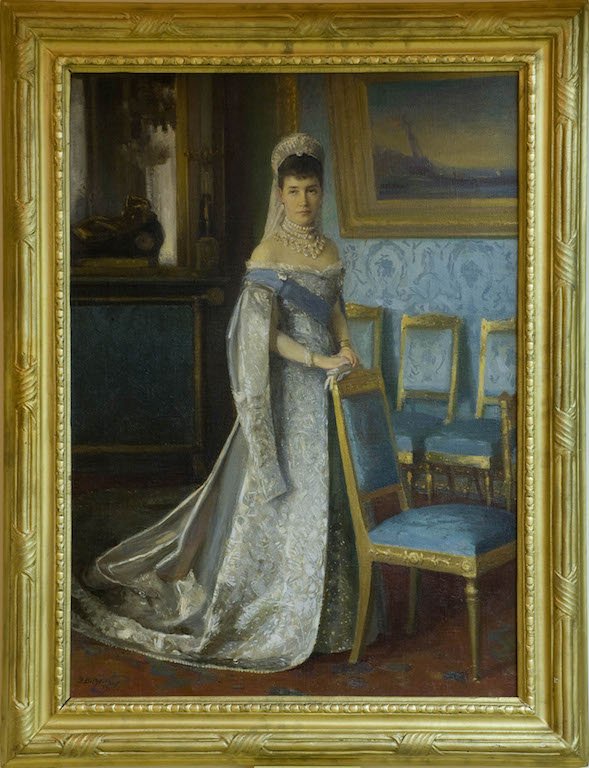
The museum sent a digital reproduction and permission to publish it in Andrei Wiesel’s work on the painter. Its colors turned out to be noticeably different from the image that had been circulating online.
In her reply the keeper of paintings asked for articles and monographs about the painter: the museum’s own biographical information was very thin. The exchange went both ways, which is a common shape for family archives: the museum holds the object, the family holds what is known about it.
Seventy years
One more thing came to light. A work enters the public domain seventy years after the author’s death. Emil Wiesel died in 1943, so from 2013 his paintings could be published freely. Reproductions soon appeared in the Wikipedia articles on the empress and on the painter himself.
The portrait is number 266 in the catalog on this site.